Cihan Geyik
AI Tools
5
min read
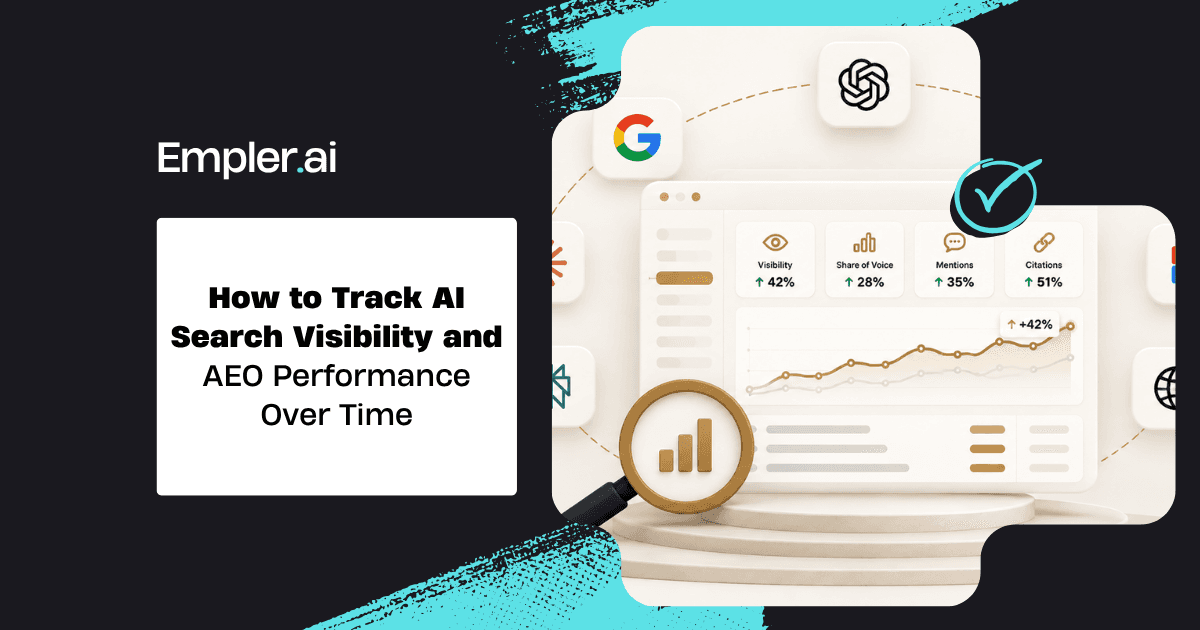
Search visibility is no longer limited to Google rankings. Brands are now being discovered, mentioned, cited, and recommended across ChatGPT, Google AI Overviews, Gemini, Perplexity, Claude, Microsoft Copilot, and other AI-powered search experiences.
That shift creates a new measurement challenge: how do you know whether your brand is actually becoming more visible across AI search — and whether that visibility is generating citations, traffic, and business impact?
TL;DR
AI search performance should not be measured with a single ranking metric. A complete measurement framework combines prompt visibility, brand mentions, citations, competitor visibility, platform coverage, historical trends, and AI referral traffic.
Modern AI Visibility Platforms bring these signals together so teams can move from simply monitoring AI answers to understanding where they need to improve.
What Is AI Search Visibility?
AI search visibility measures how frequently and prominently a brand, website, product, or entity appears in AI-generated answers.
Unlike traditional SEO, there is not always a fixed list of ten blue links or a single ranking position to monitor. An answer engine may mention a brand without linking to it, cite several sources while recommending another company, or generate different responses to variations of the same question.
This means AI visibility needs to be measured across several dimensions at once.
An effective AI Visibility Tool should help teams understand not only whether they appear in AI answers, but why they appear, which sources are being cited, where competitors are gaining visibility, and how these patterns change over time.
What Should You Track in AI Search?
Tracking hundreds or thousands of AI responses is useful only when those responses can be converted into meaningful signals. For most organizations, AI search measurement should cover at least six areas:
Prompt visibility: Which important questions and prompts include your brand.
Brand mentions: How often answer engines mention your company, products, or entities.
Citations: Which domains and exact URLs AI systems use as supporting sources.
Competitor visibility: Where competitors appear when your brand does not.
Platform coverage: How performance differs between ChatGPT, Google, Gemini, Perplexity, Claude, and Copilot.
AI traffic: Whether AI visibility ultimately generates visits to your website.
Bringing these signals into one AI Search Intelligence platform makes it possible to analyze the journey from an AI-generated answer to a citation, website visit, opportunity, and optimization action.
Track Visibility Across Individual AI Platforms
Measuring AI visibility as one aggregated number can hide important differences between answer engines. Each platform retrieves information, generates answers, and selects citations differently.
Platform-level tracking therefore helps teams identify where visibility is growing and where important gaps remain.
ChatGPT Visibility
ChatGPT has become an important discovery layer for research, product comparisons, recommendations, and informational searches.
Brands can monitor whether they appear for important prompts, how frequently they are mentioned, which competitors appear alongside them, and which websites are cited as supporting sources.
A ChatGPT visibility tracker can turn these individual responses into historical visibility data that can be monitored over time.
Google AI Overviews
Google AI Overviews add another layer to traditional search measurement. Ranking organically for a query does not necessarily mean a website will be selected as a source within the AI-generated answer.
Using a Google AI Overviews rank tracker helps teams monitor which queries trigger AI Overviews, whether their brand or website appears, and which sources Google selects for citations.
Google AI Mode
Google's conversational AI search experiences can expand a single query into multiple related searches and follow-up questions. That makes visibility measurement broader than tracking a single keyword position.
Teams can use a Google AI Mode visibility tracker to understand how their brand performs within these AI-driven search journeys.
Gemini Visibility
Gemini visibility can reveal how Google's AI ecosystem understands a brand and when it surfaces that brand for relevant questions and recommendations.
A Gemini visibility tracker can help monitor brand mentions, prompt coverage, citations, and changes in visibility over time.
Perplexity, Claude, and Microsoft Copilot
The same principle applies across other answer engines. Organizations should understand whether visibility is concentrated on one platform or distributed across the broader AI search ecosystem.
Platform-specific monitoring can include a Perplexity visibility tracker, Claude AI visibility tracker, and Microsoft Copilot visibility tracker.
How to Increase AI Citations
Being mentioned in an AI answer and being cited as a source are different outcomes.
A brand may appear frequently while its own website receives very few citations. In other cases, AI systems may learn about the brand through third-party publishers, review websites, forums, or other authoritative sources.
Improving AI citations therefore starts with understanding the existing citation landscape.
Teams should identify which prompts generate citations, which URLs are selected, which competitor pages repeatedly earn citations, and which third-party domains answer engines rely on within the topic.
This is where AI Citation Intelligence becomes particularly useful. Instead of treating citations as a simple count, teams can analyze citations by prompt, platform, domain, URL, competitor, and source type.
That data can reveal practical opportunities. If competitors are repeatedly cited for a topic where your website has little coverage, the gap may point to a content opportunity. If authoritative third-party publications are consistently used as sources, those domains may become important targets for digital PR, expert contributions, partnerships, or brand mentions.
The goal is not simply to publish more content. It is to understand the information and sources answer engines trust for a topic, then improve your own content, authority, and entity presence accordingly.
Measure Whether AI Visibility Generates Traffic
Visibility metrics tell only part of the story. A brand can increase its presence in AI answers without seeing a corresponding increase in website visits.
This is why AI search measurement should eventually connect answer-engine visibility with analytics data.
AI Traffic Analytics can help teams understand which AI platforms are sending visitors, which landing pages receive that traffic, and how AI referrals evolve alongside visibility and citation performance.
This creates an important distinction between AI visibility and AI traffic. Visibility measures presence inside AI-generated experiences. Traffic measures the users who continue from those experiences to your website.
Both matter, but they answer different questions.
Which Tools Track AI Search Visibility and Answer Engine Optimization Performance Over Time?
AI search visibility tools increasingly monitor how brands perform across answer engines, but the scope of those platforms can vary significantly.
When evaluating a platform, avoid looking only at whether it provides an AI visibility score. A useful long-term measurement system should make it possible to understand the signals behind that score.
Key capabilities to evaluate include:
Multi-platform AI visibility tracking
Prompt-level monitoring
Historical visibility trends
Brand mention tracking
Website and third-party citation monitoring
Competitor benchmarking and share of voice
AI referral traffic analytics
Content and optimization insights
Integrations with first-party search and analytics data
The ability to turn detected opportunities into measurable actions
Teams researching the market can compare AI Search visibility and AEO tools based on these capabilities rather than relying on a single visibility metric.
Why Historical AI Visibility Matters
A single AI answer is only a snapshot. Answer engines change constantly as models, retrieval systems, search indexes, source selection, and user prompts evolve.
Historical tracking makes it possible to distinguish temporary fluctuations from meaningful changes in visibility.
For example, a brand might gain mentions across a group of commercial prompts after publishing new comparison content. Citation coverage might improve after authoritative websites begin referencing the company. Visibility on one platform may rise while another platform remains unchanged.
These patterns become much easier to identify when prompt, citation, competitor, and platform data are measured continuously rather than through occasional manual searches.
From AI Visibility Tracking to Improvement
Monitoring is only the first stage of AI search optimization.
The more valuable question is what a team should do after discovering a visibility gap.
A useful workflow can be summarized as:
Track → Analyze → Discover → Improve → Measure again.
A missing citation may lead to a content improvement. A competitor visibility gap may reveal a new topic cluster. Repeated citations from third-party websites may create a digital PR opportunity. Strong AI visibility but weak referral traffic may indicate that landing pages or conversion paths need attention.
Connecting these signals through a complete AI Search workflow helps move AI visibility programs beyond dashboards and toward measurable optimization.
AI Search Measurement Is Becoming a New Analytics Layer
Traditional SEO analytics were built around keywords, rankings, impressions, clicks, and conversions. Those metrics remain important, but AI-generated search experiences introduce additional layers between a user's question and a website visit.
Brands now need to understand questions such as:
Does the answer engine know our brand?
Does it mention us for commercially important questions?
Does it recommend competitors instead?
Which websites influence those answers?
Which of our pages are being cited?
Are those citations increasing over time?
Does AI visibility translate into website traffic?
Together, these questions create a new intelligence layer between search demand, brand authority, content, and analytics.
Frequently Asked Questions
What is AI visibility tracking?
AI visibility tracking measures how often and in what context a brand, product, website, or entity appears across AI-generated answers. It can include prompt visibility, mentions, citations, competitors, share of voice, and historical performance.
How do you track brand visibility in ChatGPT?
Brands can monitor a consistent set of relevant prompts and record whether ChatGPT mentions the brand, which competitors appear, what context the brand appears in, and which domains or URLs are cited. Tracking the same prompt set over time makes visibility trends easier to measure.
How do you track Google AI Overviews?
Google AI Overview tracking typically monitors queries that trigger AI-generated results, whether a brand or domain appears within those results, and which URLs Google uses as supporting citations.
How can a website increase AI citations?
Start by analyzing which sources answer engines currently cite for important topics. Compare your citation coverage with competitors, identify content and authority gaps, improve pages that directly answer relevant questions, and strengthen your presence on authoritative third-party sources used by AI systems.
What is AI traffic analytics?
AI traffic analytics focuses on visits originating from AI and answer-engine platforms. It helps connect AI visibility with website sessions, landing pages, referral sources, and downstream business performance.
Is AI visibility the same as SEO ranking?
No. Traditional ranking measures a page's position within search results. AI visibility can involve brand mentions, recommendations, citations, and source selection inside generated answers, where there may be no conventional ranking position at all.
Final Thoughts
AI search is changing how brands are discovered. Measuring that shift requires more than checking a few prompts manually or assigning a single visibility score.
Organizations need to connect prompts, mentions, citations, competitors, platform visibility, historical trends, and traffic to understand how their presence across answer engines is actually changing.
Ansvisor is an open-source AI Search Intelligence platform designed to connect these signals across the AI search workflow — from visibility and citations to traffic, opportunities, and optimization.